
A capture layer for the web

Save withoutbreaking flow.

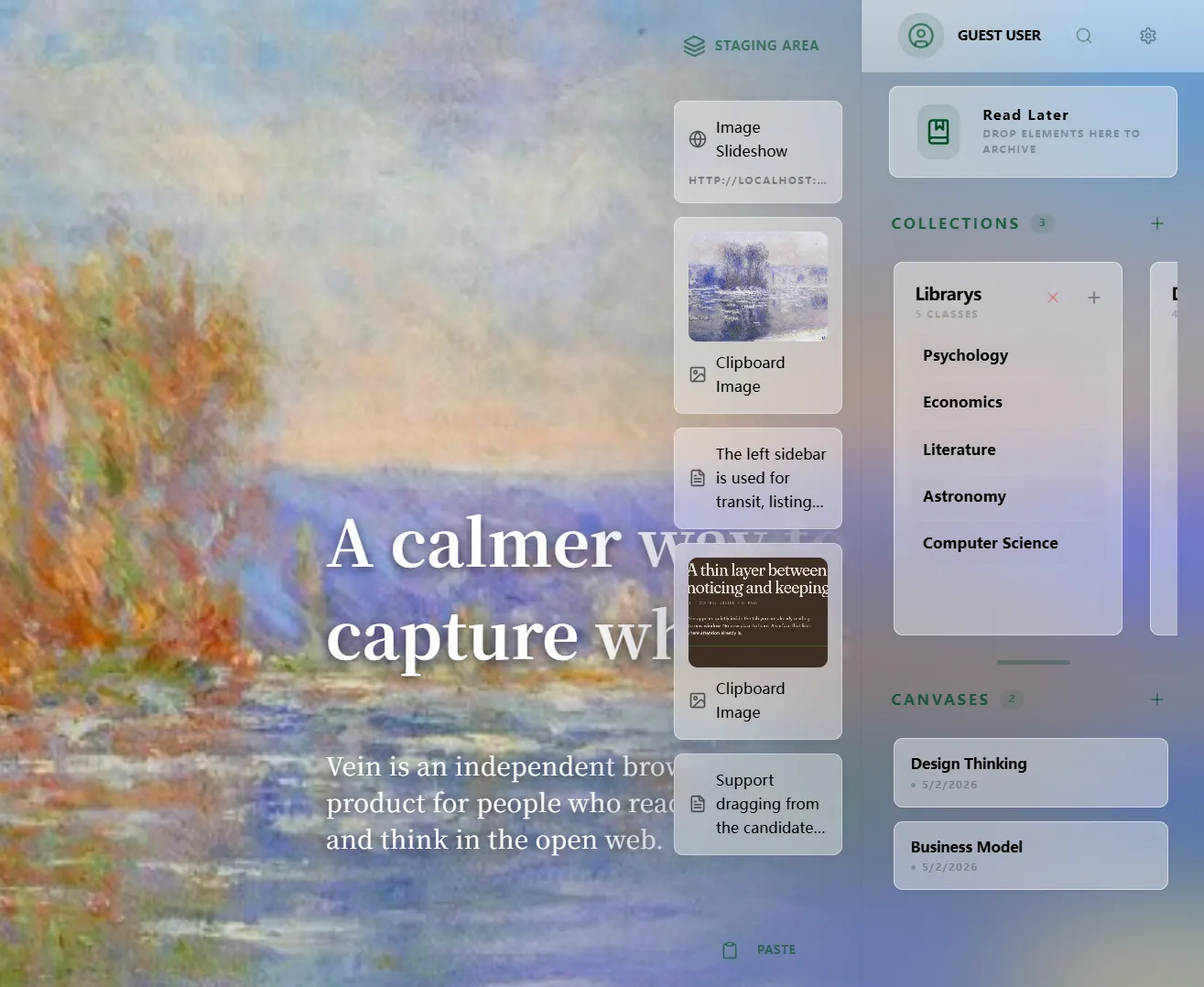
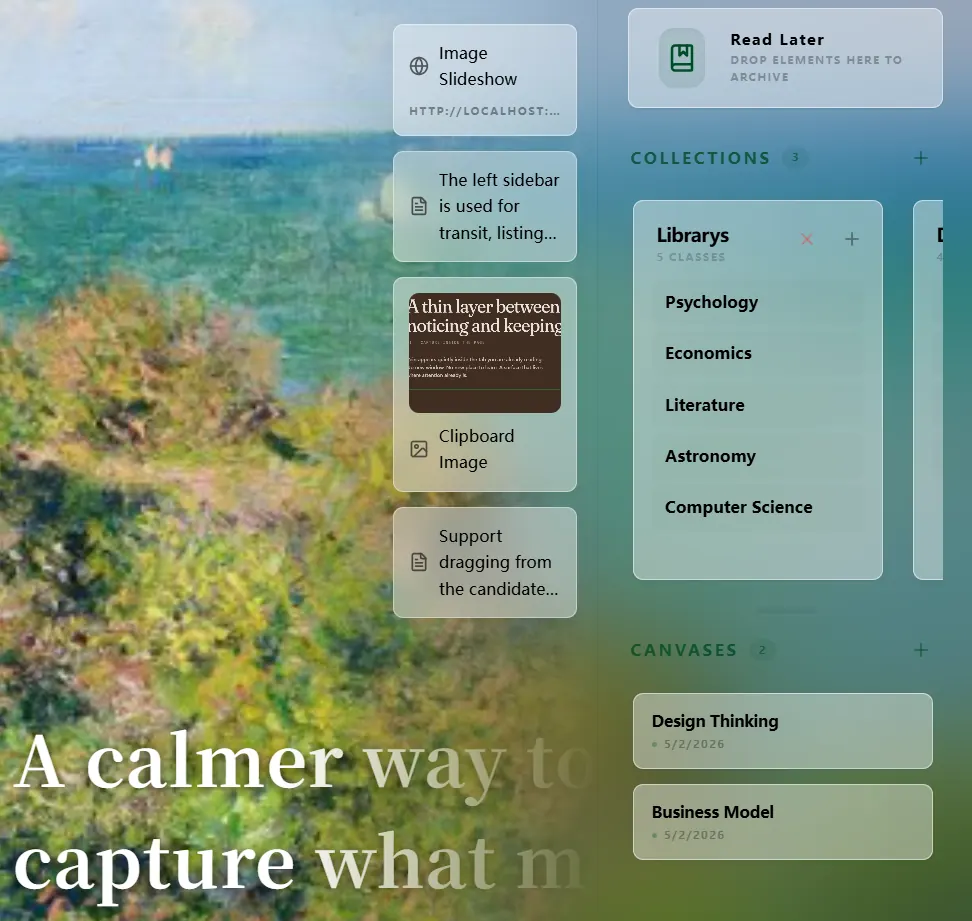
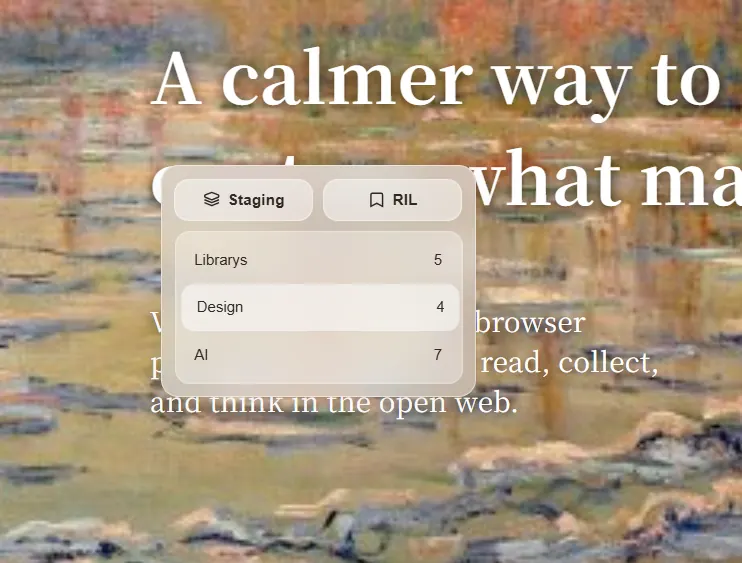
Vein is a locally-first browser knowledge capture layer. It lets you capture, edit, browse, and structurally organize within the current page, then freely flow into Obsidian, Notion, or your other systems.

Definition
Capture layer
Trust
Data local storage
Promise
Core features permanently free
Vein hero preview

§ 01 — Observed

The hidden cost of saving.

Every act of saving on the web demands a small departure. We leave the page, choose a place, decide on a shape, and return to a thought that no longer waits for us.

The pattern is so familiar it has become invisible. Vein begins from the simple observation that this departure has a cost — and that the cost compounds.

  1. 01

    Open another tab.

    The pattern, today

  2. 02

    Choose a folder, page, or database.

    + interruption

  3. 03

    Decide on structure too early.

    The pattern, today

  4. 04

    Return to the page.

    + interruption

  5. 05

    Lose the thread of thought.

    The pattern, today

The pattern is so familiar it has become invisible. Vein begins from the simple observation that this departure has a cost — and that the cost compounds.

§ 02 — Definition

What is a capture layer?

Capture is not management. Most tools optimise for the place where things are kept; few attend to the moment they are noticed. Vein sits between the browser and your long-term system — reducing the cost of preserving value at the exact instant it appears.

BeforeWithout capture layer

Browser

Reading, noticing

PKM system

Organize & manage

Every act of saving on the web demands a small departure. We leave the page, choose a place, decide on a shape, and return to a thought that no longer waits for us.

TodayWith Vein

Browser

Reading, noticing

Vein

Capture, lightly

Your system

Organize & manage

Capture is not management. Most tools optimise for the place where things are kept; few attend to the moment they are noticed. Vein sits between the browser and your long-term system — reducing the cost of preserving value at the exact instant it appears.

i.
No context switch

ii.
Light structure

iii.
Reliable export

§ 03 — The capture surface · Chapter 1 of 4

The capture surface I

A thin layer between noticing and keeping.

01 · Capture inside the page

Vein appears quietly inside the tab you are already reading. No new window. No new place to learn. A surface that lives where attention already is.

Chapter 1 preview
Scroll to advanceI · A thin layer between noticing and keeping.

§ 04 — Internal architecture

Different kinds of material need
different kinds of holding space.

Vein does not reduce everything to bookmarks. Just enough shape to remain useful later — never more than that.

Supported blocks

  • Linksurl + meta
  • Markdowntext snippets
  • Imagesfig. + caption
  1. IHierarchy

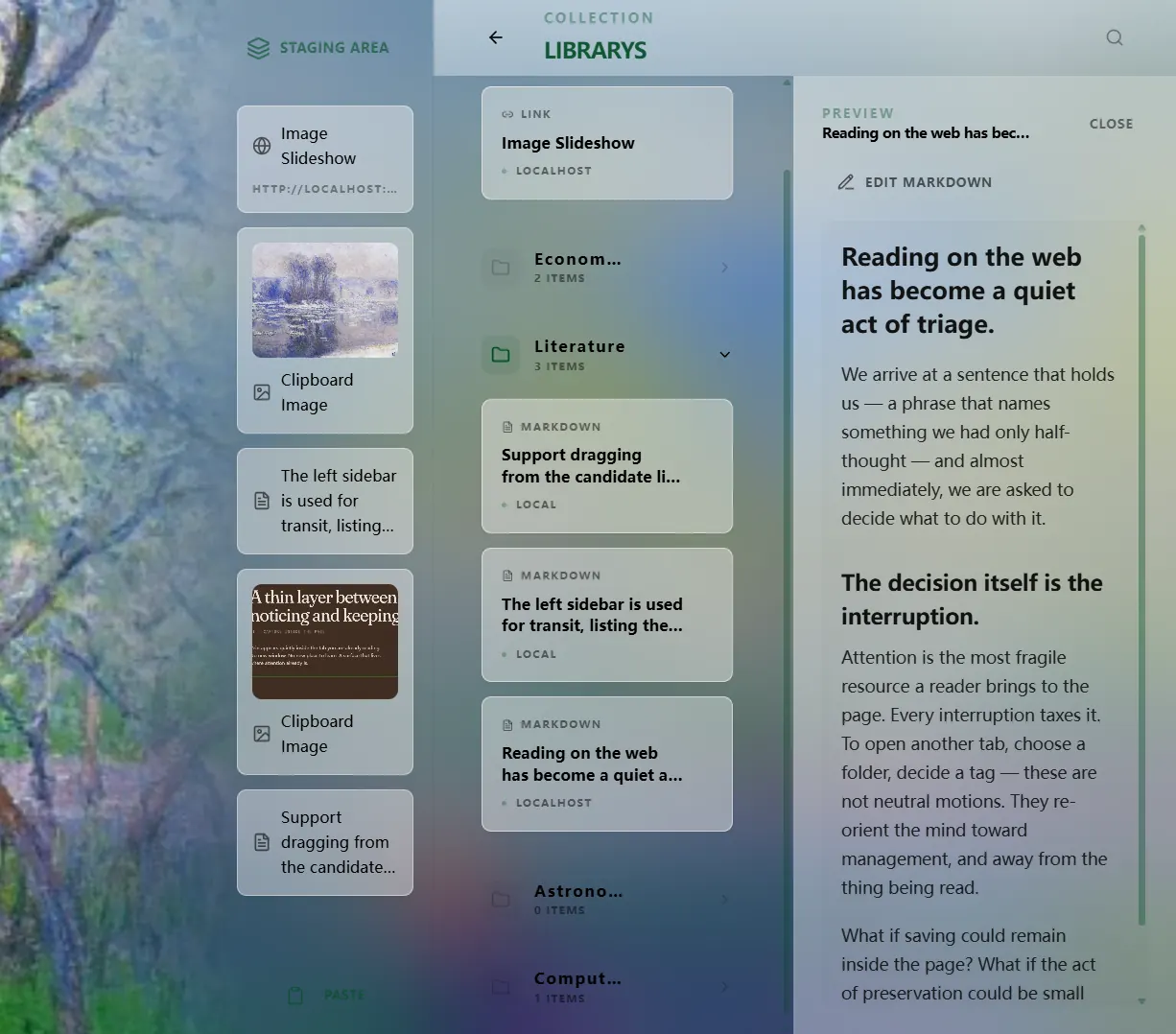
    Collections

    A lightweight two-level structure for organised saving — material that should remain stable and navigable.

    • Attention & focus / Reading rituals
    • Writing systems / Drafts
    • Quiet software / Local-first
  2. IIQueue

    Read it later

    A linear queue for things worth revisiting. Built for deferred attention and patient return.

    • The Cost of Interruption · 14 min
    • Notes on Slowness · 7 min
    • On Reading in Public · 22 min
  3. IIIVisual

    Canvas

    A flexible visual surface for grouping, annotating, and thinking spatially. For looser, associative shape.

    • Cluster — Ambient research
    • Loose threads — December
    • Map — Calm software

Vein does not reduce everything to bookmarks. Just enough shape to remain useful later — never more than that.

This is not a heavy information architecture, but a quiet map, marking the space where captured material dwells between perception and internalization.

§ 05 — One unbroken chain of attention · Scene 1 of 5

Workflow I

You are reading

You notice something worth keeping.

A sentence, a chart, an image. The moment is fragile. Recognition arrives before any decision about what to do with it.

longform.review/essays/the-cost-of-interruption
The Cost of Interruption — Longform Review
inbox · vein
drafts

Essay · 14 min read

The cost of interruption

Margaret Holroyd · December 2025

Reading on the web has become a quiet act of triage. We arrive at a sentence that holds us — a phrase that names something we had only half-thought — and almost immediately, we are asked to decide what to do with it.

The decision itself is the interruption. Attention is the most fragile resource a reader brings to the page. Every interruption taxes it. To open another tab, choose a folder, decide a tag — these are not neutral motions. They re-orient the mind toward management, and away from the thing being read.

What if saving could remain inside the page? What if the act of preservation could be small enough to leave the thread of thought unbroken?

Bridge to your systemYou are reading

§ 06 — Principles

Three convictions, held quietly.

  1. i.

    In-page capture

    Stay inside the current page. Capture happens where attention already is.

  2. ii.

    Context preserved

    Keep the excerpt, the source, the time. Capture is more than a link.

  3. iii.

    Local-first, export-first

    Own your data. Move it freely. Vein is a bridge, never a cage.

§ 07 — Local-first & trust

Fully master the content you capture.

Vein is built on the assumption that the things you save matter and that you should be able to leave at any moment without losing them.

Primary copy lives locally

Stored on your device, using an open format.

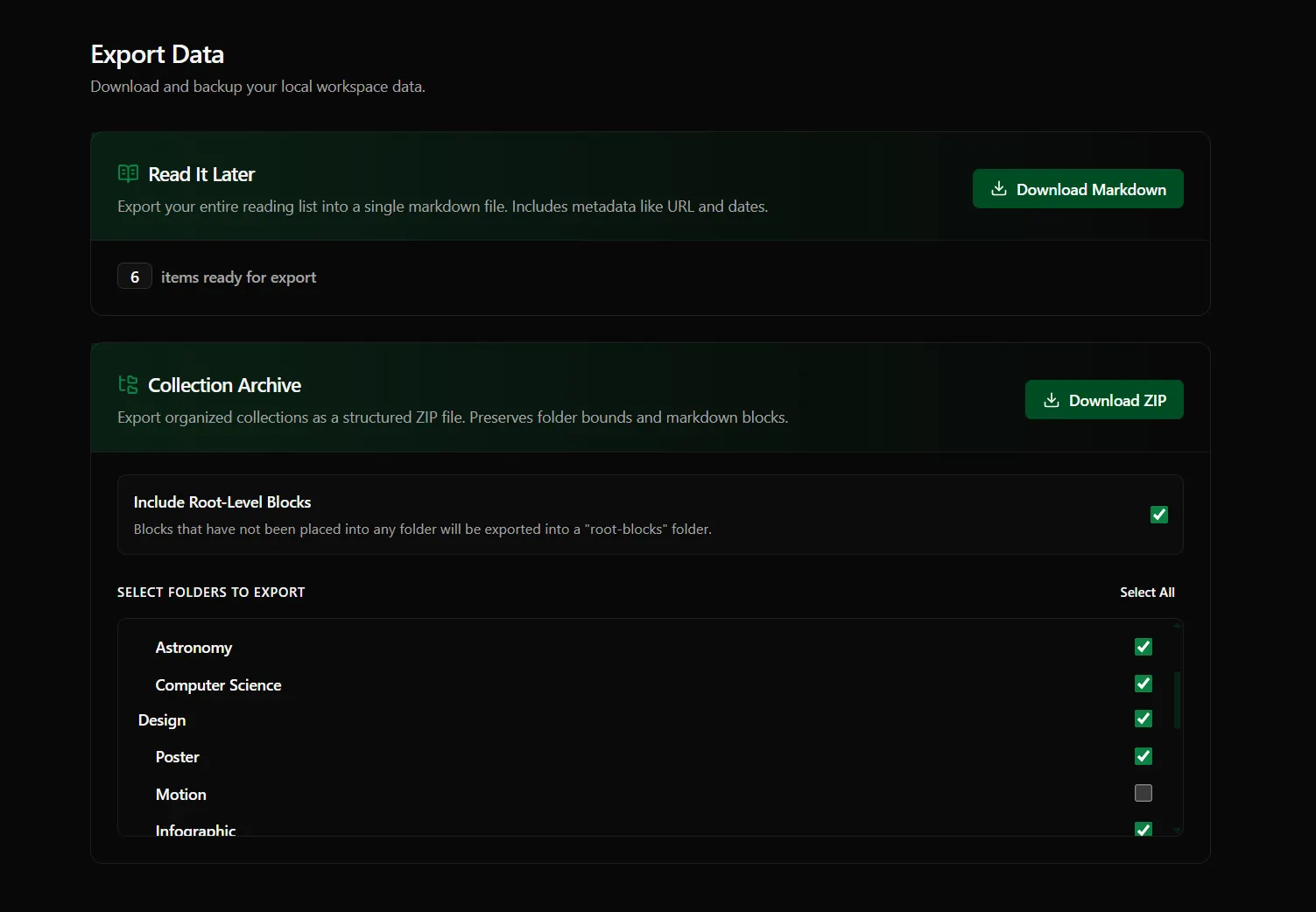
Stores data in the browser's Indexed DB. Uses an open format.

The data model is open

Full control, no proprietary locking.

Ensures you can access them without relying on Vein.

Can capture offline as well

Can operate completely offline.

Saved locally, no internet connection required.

Export is built-in from the start

It's not a future feature, but a core commitment.

Vein bridges your existing tools, it doesn't replace them.

Vein is just a tool for accessing content, it doesn't claim your data.

§ 08 — Positioning

Brief clarifications.

Vein is intentionally narrow in scope. These are the boundaries that keep it useful.

  • Notion and Obsidian are long-term knowledge systems. Vein is the layer before them — the surface where things are first noticed and kept. Vein hands material off to those tools cleanly; it does not try to replace them.

  • A bookmark saves a URL. Read-it-later apps save articles to read again. Vein preserves arbitrary fragments — quotes, images, notes, links — with their context, in lightweight structures designed for later reuse, not just later reading.

  • Your captures are part of your thinking. They should live on your device, in formats you can open without us. Local-first also means offline capture, instant response, and no dependency on a service staying online.

  • Yes. Vein commits to keeping its core functionality permanently and completely free. Capture, organize, and export your material without a paywall. If premium features ever appear, they will be additive and never remove this core promise.

§ 09 — Close

If your work beginsin the browser,your capture workflow should too.

Download

Install Vein

A lightweight, local-first browser extension that asks little of you.

Get updates & beta invites

Stay close to the project

Leave your email to receive meaningful product updates, release notes, and invitations to future beta versions. No marketing list. No noise.

Just occasionally written quiet notifications. Can unsubscribe with one click.